
Rent Aerial Work Platforms and Construction Machinery in Dietikon
Anyone renting aerial work platforms and construction machinery in Dietikon is typically working in one of two environments: the distribution and cross-dock warehouses of the Limmat Valley between Silbern, Lerzen and Niderfeld — or the transport infrastructure that runs the length of the valley. Both place very different demands on rental equipment. Inside the warehouse, aisle width, ground pressure and a drive with zero local emissions matter most; at the track and overhead line, set-up time and stability determine whether a single possession window is enough. Luibl provides inspected equipment for both situations and delivers to the site in the Limmat Valley on its own low-loader.
High-bay racking, aisle width and warehouse roof: aerial work platforms in distribution operations
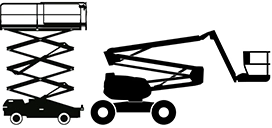
A modern distribution centre in the Limmat Valley is organised vertically and tight on floor space. For rack assembly, rack inspection, replacing light strips and servicing sprinkler lines under the warehouse roof, you need equipment that reaches eaves height without blocking the aisle. That is exactly what high-rack scissor lifts are built for: they reach 18.50 to 33.00 m working height at 450 to 1,000 kg platform capacity while staying narrow enough for the gap between two rows of racking. The high platform capacity is the real point — cross-beams, shelf panels and frame parts travel up with the operator instead of being handed up piece by piece.
Where the aisles are wider and no high-bay racking is involved, electric scissor lifts from 6.30 m working height are enough. They are locally emission-free, run on non-marking tyres and are suitable for lighting, fire detection systems and ceiling suspensions during ongoing operations. Overhead runs interrupted by an obstacle — a conveyor, an intermediate platform, a sprinkler control unit — are better reached with an articulated boom lift, because its platform can be guided around the obstacle to the work location.
Plan the deployment around the operational schedule: warehouse work in a cross-dock centre can rarely be completed in one go. It makes sense to schedule the platform across several night shifts or over a weekend and to clear the aisles section by section. Agree the rental period together with your logistics management — this avoids manoeuvring with the platform raised, which is not permitted in any case.
Track, overhead line and possession window: deployments on transport infrastructure
The second major source of demand in Dietikon is the expansion of the valley's transport corridors. Work on overhead lines, signalling systems, noise barriers, underpasses and bridge parapets almost always takes place within a fixed time window — the possession. The machine must already be in position, outriggers set and isolated by the time the window opens. Tracked aerial platforms with 13.00 to 39.50 m working height have proven themselves here: they travel over ballast, verges and site tracks, spread their weight through the tracks and can be set up even where a wheeled machine would sink in.
For work with a large outreach — lighting masts, gantry signs, top-of-embankment edges — use telescopic boom lifts, which reach up to 56.90 m working height at 227 to 454 kg platform capacity. Near railway installations, observe the infrastructure operator's requirements on safety clearances, earthing and slew limitation; the platform itself is not modified for this — the working area is restricted organisationally instead. For inspection rounds on gantries and wall surfaces with no obstacle, a mast lift with 10.00 to 12.65 m is often enough — it fits through doorways, is set up quickly and can be cleared from the possession again within minutes.
The rental fleet in figures
| Class | Working height | Platform capacity |
|---|---|---|
| Scissor lifts, electric | 6.30 – 33.00 m | 227 – 1,000 kg |
| Scissor lifts, diesel | 9.70 – 34.00 m | 363 – 1,134 kg |
| High-rack scissor lifts | 18.50 – 33.00 m | 450 – 1,000 kg |
| Articulated boom lifts | 10.89 – 48.15 m | 150 – 450 kg |
| Telescopic boom lifts | 14.00 – 56.90 m | 227 – 454 kg |
| Mast lifts | 10.00 – 12.65 m | 200 kg |
| Tracked aerial platforms | 13.00 – 39.50 m | 200 – 400 kg |
Telehandlers, excavators and forklifts for cross-dock operations
Height is only part of it — handling matters too. In Dietikon, telehandlers close the gap between forklift and crane: fixed-boom machines with 4.30 to 18.80 m lift height and 1.25 to 25 t lifting capacity for deliveries and material flow in the yard, and rotating models with 15.42 to 38.90 m and 4 to 8 t when loads have to be set down over a parapet or canopy. For the interior of a warehouse, electric telehandlers with 5.85 to 30.00 m and 2.5 to 7 t are available.
In civil engineering around the site development areas, excavators from 1.8 to 30 t operating weight are in use — the smaller classes for utility trenches and demolition between existing structures, the larger ones for excavation and ground improvement. In the warehouse, forklifts from 3 to 16 t and high-lift stackers with 2.70 to 5.50 m lift height and 1.2 to 2.0 t capacity round out the fleet when peak handling volumes or a racking conversion call for additional vehicles.
Inspection certificates and operator duties in the Canton of Zurich
Especially for deployments in third-party logistics facilities and during possession windows, paperwork is checked before anyone steps onto the platform. The legal framework is Swiss: the Ordinance on the Prevention of Accidents and Occupational Diseases (VUV) applies, with implementation and oversight carried out by SUVA and supplemented by EKAS guidelines; above these stand the Labour Act and its ordinances. The recurring inspection of mobile elevating work platforms follows SN EN 280. Luibl hands over the current inspection certificate, CE documentation and the operating manual with every machine — so you can prove clearance to the warehouse operator or the infrastructure operator without further queries. The risk assessment for the specific site, operator instruction and the visual and functional check before work begins remain the renter's responsibility.
Transport to Dietikon
Dietikon has good transport links on the western edge of the Zurich agglomeration; access to the commercial areas is straightforward via the valley axis, though access to an individual warehouse often is not. When you send your enquiry, let us know the gate height, the permitted axle load in the yard and whether unloading is via ramp or at ground level. For deployments in the track area, we coordinate the delivery time with the possession window so the machine is in place before it opens. If your project is broader in scope, we coordinate the rental fleet together with our locations in Zurich and Winterthur, so several machines can be scheduled at the same time.
Frequently Asked Questions
Which aerial work platform fits the racking aisle of a Limmat Valley distribution centre?
As a rule, a high-rack scissor lift. It reaches 18.50 to 33.00 m working height and carries 450 to 1,000 kg, while staying narrow enough for the gap between two rows of racking. What matters is the clear aisle width including any protruding load carriers — measure at the narrowest point, not from the plan dimension. If the height does not reach all the way to the roof, we will work with you to check an alternative from the electric scissor lift range, or an articulated boom lift for the open area in front of the racking.
Is diesel-powered equipment allowed to work inside a warehouse in Dietikon?
Inside an enclosed warehouse, that is the exception, and it depends on ventilation and the operator's approval. The standard solution is electric drive: locally emission-free, quiet and fitted with non-marking tyres. We deploy diesel machines in the yard, at the ramp and on paved outdoor areas. When indoor and outdoor work overlap, we schedule two machines rather than one compromise.
How do I prepare a platform deployment for a possession window?
The machine should already be in position before the window opens, with outriggers set and a function check completed. Clarify in advance the standing area and its load-bearing capacity, the safety clearances to live parts, and who will operate the machine during the possession. Tracked aerial platforms have proven effective here, since they travel over ballast and verges and need no paved standing surface. We coordinate delivery to match your time window.
Which machine can reach an overhead line or a lighting mast above an embankment?
Here, lateral outreach matters more than sheer height. Telescopic boom lifts with up to 56.90 m working height and 227 to 454 kg platform capacity reach points that no path leads to from below. If the machine stands on soft ground, support plates under the outriggers are mandatory. Send us a photo of the setup situation along with the distance to the work point, and we will suggest the right class of machine.
Can Luibl supply several machines at once for a warehouse conversion in Dietikon?
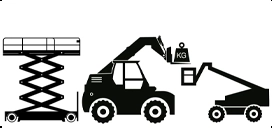
Yes, that is the normal case for racking conversions and roof-level technical work. A typical combination is two to three scissor lifts for the floor area, one telehandler for material supply, and one high-lift stacker for order picking during the conversion phase. Register your requirement at the start of the planning phase so the machines stay reserved for the full duration of the project.
Before you enquire, it is worth looking at the designs: at Rent a lifting platform you will find all platform types from the scissor lift to the truck-mounted platform with their strengths, typical applications and operator duties.