Rent hybrid and bi-energy scissor lifts from 11.75 m to 27.20 m: diesel for rough terrain, electric for indoor work. Check availability now.
Rent a Hybrid Scissor Lift – Diesel for the Approach, Electric for the Hall
A hybrid scissor lift solves a problem that comes up constantly on real projects: the machine has to cross unpaved ground to reach its work area and then operate inside an enclosed hall where exhaust fumes and noise are not permitted. Renting two machines for this means paying for two transports and two rental items. The Luibl rental fleet includes four scissor lifts with switchable drive – working heights from 11.75 m to 27.20 m, load capacities from 363 kg to 1,000 kg. All machines are inspected before handover in accordance with the inspection cycles of the VUV / SUVA guidelines (incl. EKAS) and SN EN 280.
Two drive concepts sit behind the term:
-
Bi-energy: A diesel generator charges the battery and handles travel on rough terrain; for lifting and driving indoors, the machine switches to pure battery operation. The diesel engine stays off.
-
Hybrid: Diesel and electric drives are permanently combined, and the control system selects the operating mode depending on load or by operator preselection. Typical of the heavy rough-terrain scissors with four-wheel drive.
In practice, both mean the same thing: one machine, two working environments, one transport.
The Hybrid and Bi-Energy Scissor Lifts in the Rental Fleet
| Code | Model | Working height | Load capacity | Platform extended × W × H | Drive |
|---|---|---|---|---|---|
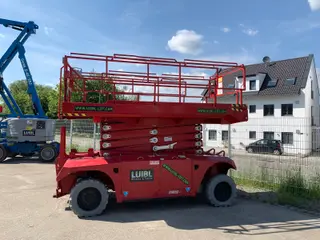
| SBH-270 | Holland Lift M250HYL25 Combistar 4WD P/N | 27.20 m | 1,000 kg | (8.25 m) × 6.15 m × 2.35 m | Hybrid |
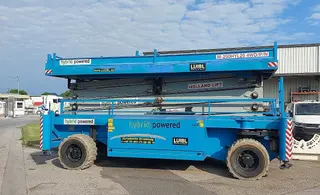
| SBE-150A | PB S151-19EGI 4x4 | 15.00 m | 500 kg | (6.36 m) × 4.11 m × 1.88 m | Bi-energy |
| SBE-141 | Genie GS 4069DC | 14.12 m | 363 kg | (4.31 m) × 2.79 m × 1.60 m | Bi-energy |
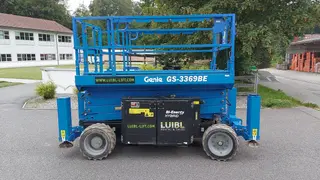
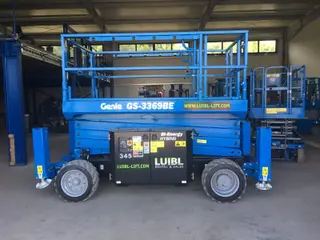
| SBH-118 | Genie GS 3369BE | 11.75 m | 454 kg | (4.31 m) × 2.79 m × 1.60 m | Bi-energy |
The Heavy-Duty Class: 27 m Working Height with 1,000 kg
The Holland Lift M250HYL25 Combistar 4WD is the only machine in the rental fleet that combines 27.20 m working height, 1,000 kg platform load capacity and four-wheel drive with a switchable drive concept. The platform extends to 8.25 m – the basic prerequisite when facade elements, ventilation runs or sandwich panels are to be worked on in a single lift without repositioning the machine. Typical applications: facade installation on multi-storey logistics halls, steel construction assembly in plant engineering, roof work followed by interior fit-out.
The Mid-Range Class: 12 m to 15 m for Alternating Operation
The three bi-energy machines cover the range in which most alternating projects fall – commercial construction, hall refurbishment, ventilation and sprinkler installation on sites that do not yet have a reliable mains connection.
-
PB S151-19EGI 4x4 – 15.00 m working height, 500 kg load capacity, platform extendable to 6.36 m, four-wheel drive. The strongest of the three when material has to go up on the platform too.
-
Genie GS 4069DC – 14.12 m working height, 363 kg load capacity, compact footprint of 2.79 m × 1.60 m. Fits through site gates that are too narrow for the larger rough-terrain scissors.
-
Genie GS 3369BE – 11.75 m working height, 454 kg load capacity, same footprint as the GS 4069DC with a higher load capacity. The choice for two-person installation work with tools.
When a Hybrid Scissor Lift Pays Off Compared with Two Machines
The switching capability comes with a rental surcharge compared with a pure electric scissor of the same working height. It pays off as soon as one of these four points applies:
-
No reliable mains connection at the work site. On shell construction sites, the site power supply is usually fully allocated. Anyone using an electric scissor without guaranteed overnight charging loses working time on the second day. The diesel generator charges independently of the mains.
-
The machine has to cross terrain to reach its position. Topsoil, gravel, sloping site access roads: electric scissors with non-marking tyres are not designed for this. The hybrid machines in the fleet have four-wheel drive.
-
Indoor and outdoor use alternate over the course of the project. Facade first, interior fit-out afterwards – a classic pattern in commercial and logistics construction. Changing machines means two transports, two briefings and a gap in the construction schedule.
-
Emission requirements indoors. In food processing plants, cleanrooms and operating logistics facilities, diesel operation is ruled out. Pure battery operation meets the requirements for locally emission-free work without sacrificing terrain capability for the approach.
If none of these points applies, the pure electric scissor lift or the diesel scissor lift is the more economical choice.
Switching Technology: What Site Managers Should Know in Advance
Switching when stationary, not under load. The operating mode is changed with the machine at a standstill via the ground control or – depending on the model – via the platform control. Switching during a lifting operation is not provided for by design. For deployment planning, this means the operating mode is selected before setting up, not during work.
Battery capacity determines indoor operating time. In pure electric mode, operating time is limited by the battery. As a planning figure, allow one working day on a full charge with a normal lifting/travel profile. For multi-shift indoor operation, either a charging break must be scheduled or the generator must be used for recharging outside the emission-sensitive area.
Check the choice of tyres. Terrain capability and non-marking properties are two separate requirements. If the machine continues working on a coated hall floor after outdoor use, the tyres must be clarified explicitly when enquiring – please state this in your enquiry.
Weight and wheel load. Switchable machines carry both a generator and a battery pack. Their total weight is higher than that of a pure electric scissor of the same working height. For work on slabs in underground car parks or upper floors, the wheel load of the specific model is decisive, not the total weight – we provide the data sheets before the rental.
Outriggers and ground incline. The rough-terrain models level themselves via hydraulic outriggers. The permissible ground incline during operation is model-specific and documented in the data sheet; the tilt sensor shuts off the lift function if it is exceeded.
Inspection Obligations, Safety and Logistics
Every scissor lift from the Luibl rental fleet undergoes inspection in accordance with VUV and is checked by our workshop staff before every delivery. Standard equipment includes a tilt alarm, overload protection, a mechanical emergency lowering system and emergency lowering from the ground on both sides. For operation, the following continues to apply: operating personnel must be instructed in accordance with VUV and the EKAS guideline, and personal fall protection equipment is mandatory on the platform. For training, we refer you to IPAF/PAL-Card-certified partners. With switchable operation, two further points apply: * The briefing must cover both operating modes – in practice, operating errors occur mainly during switching. * If the diesel generator is run in enclosed spaces, the ventilation requirements of ArGV 3 apply. This is exactly what electric operation is meant to avoid; the operator's operating instructions should regulate this clearly. Transport is carried out with our own low-loader fleet, with delivery throughout Switzerland and to all other Luibl markets: Germany, Austria, Poland, Czech Republic, Italy, Hungary, Luxembourg. For long-term rentals, we offer combined packages including inspection in accordance with VUV and annual maintenance during the rental period.
You know which working height and which operating mode you need? Send us the working height, load capacity, work site, rental duration and – if relevant – the required tyres. We will get back to you at short notice with a quote and availability.
Submit a Request Now → luibl.eu/kontakt/ · +49 851 756868-0
