Who May Carry Out the Work Equipment Inspection? The Specialist Explained
Short Answer: Who May Carry Out the Inspection?
The question "who may inspect?" has a clear answer — and considerable practical consequences if it is answered wrongly. A check by a person without the required specialist knowledge is worthless: the record counts as not provided, and the work equipment as unchecked.
The inspection must be carried out by a specialist within the meaning of EKAS Guideline 6512. That is a person with relevant training, demonstrated experience with the type of work equipment concerned, and current professional activity. For cranes, the additional requirements of the Crane Ordinance apply; there, a recognised inspection body or a correspondingly qualified specialist is required.
A note on scope: the German system of the "competent person under TRBS 1203", the "qualified person" and the "expert" does not apply in Switzerland. Anyone using German templates must convert to the terminology of the VUV and the EKAS guidelines.
The Specialist under EKAS Guideline 6512
EKAS Guideline 6512 requires the maintenance and checking of work equipment to be carried out by persons who are technically qualified to do so. In practice, three criteria are applied and must be met cumulatively:
Relevant training
The training must enable the person to understand the work equipment being inspected. For forklift checks that can be an automation technician, polymechanic or agricultural machinery mechanic; for mobile elevating work platforms a mechanic with hydraulics knowledge; for cranes an engineer or technician specialising in crane inspections.
Experience with the work equipment concerned
The experience must relate to the specific machine type. Anyone whose experience is limited to passenger cars is not a specialist for forklift checks — even with the same vocational qualification.
Current professional activity
Activity in the relevant field must be current — training in the past without ongoing practice is not sufficient. As a guide, a gap of no more than 2–3 years without practical activity involving that type of work equipment applies.
Specialist and Recognised Inspection Body: The Distinction
In Switzerland there are essentially two tiers — not three as in Germany:
| Term | Requirement | Used for | Typical actors |
|---|---|---|---|
| Specialist (EKAS 6512) | Training + experience + current activity | Periodic checking of most work equipment (forklifts, platforms, construction machinery) | Internal safety specialists, external inspectors with specialist knowledge |
| Recognised inspection body | Recognition or accreditation for the discipline | Inspection of cranes under the Crane Ordinance | Accredited inspection bodies, specialised engineering firms |
Unlike in Germany, the VUV and the EKAS guidelines have no separate intermediate category of "qualified person". What matters is whether a recognised inspection body is prescribed for the work equipment, or whether a specialist suffices. EKAS Guideline 6512 additionally requires the company's safety organisation — with occupational safety specialists where needed — to be properly set up.
Who May Inspect Which Machine?
Forklifts / industrial trucks
Inspector: specialist with experience in the field of industrial trucks. No recognised inspection body required. Details: Work equipment inspection forklifts →
Construction machinery
Inspector: specialist with knowledge of the machine class concerned. Details: Work equipment inspection construction machinery →
Cranes
Here the additional requirements of the Crane Ordinance (SR 832.312.15) apply. Depending on the crane type, a recognised inspection body or a correspondingly qualified specialist is required; the Crane Ordinance also governs the requirements for the crane operator. Details: Work equipment inspection cranes →
Mobile elevating work platforms
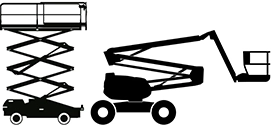
Inspector: specialist with the relevant qualification for mobile elevating work platforms; VUV Art. 32b, EKAS 6512 and SN EN 280 are decisive. Details: Work equipment inspection work platforms →
Internal or External Inspection: Deciding
A specialist can be engaged internally (within your own company) or externally (from an inspection body). Criteria for weighing this up:
Internal inspection makes sense where:
- There is a large in-house machine fleet and the corresponding qualification is available
- Inspection staff receive regular further training and are continuously active
- A maintenance plan and documentation processes under EKAS 6512 are established
External inspection makes sense where:
- The machine fleet is small or heterogeneous
- No internally qualified persons are available
- The qualification is not economically worthwhile to acquire
- Inspection by a recognised inspection body is prescribed (cranes)
For rental machines from Luibl Rental this decision falls away: as lessor, Luibl Rental takes on the organisation of inspections and delivers all work equipment with a valid inspection record.
How Do You Become a Specialist?
Qualification is obtained through external, recognised providers — Luibl Rental does not offer training or qualification measures. Possible routes:
- Courses from recognised training providers (for example ASFL SVBL, the Swiss Safety Center, TUEV)
- Training and practical guidance from Suva on the maintenance of work equipment
- Manufacturer-specific qualification programmes for certain machine classes
For inspections that require a recognised inspection body (cranes under the Crane Ordinance), in-company qualification is not possible — an accredited body must be engaged.
Rent machines with a valid inspection record → | Send an enquiry →
Frequently Asked Questions
Who may carry out the work equipment inspection?
A specialist under EKAS Guideline 6512 — with relevant training, experience with the work equipment concerned and current professional activity. For cranes, the additional requirements of the Crane Ordinance apply.
Does TRBS 1203 apply in Switzerland?
No. TRBS 1203 and the term "competent person" in that sense come from German law. In Switzerland the specialist under EKAS Guideline 6512 is decisive. The substantive requirements are similar, but the legal basis and the terminology differ.
May the boss inspect personally?
Yes — if they meet the technical requirements: relevant training, experience with the specific machine type and current activity. For cranes under the Crane Ordinance that does not automatically apply; there, a recognised inspection body is required depending on the crane type.
When must a recognised inspection body carry out the inspection?
For cranes under the Crane Ordinance. Which crane types this affects, and to what extent, is governed by the Crane Ordinance. In these cases, engaging an accredited body is mandatory.
Where can you qualify?
Through external, recognised providers: ASFL SVBL, the Swiss Safety Center, TUEV or manufacturer-specific programmes; Suva additionally provides practical guidance. Luibl Rental does not offer training or qualification.