IPAF, System-Card and Operator's License – Legal Requirements When Renting Aerial Work Platforms
Anyone renting an aerial work platform carries legal responsibility – not just for the machine, but for the person operating it. The operator's qualification is not a recommendation but a legal obligation. In Switzerland, the VUV forms the legal foundation: it stipulates that aerial work platforms may only be operated by people who have been explicitly assigned to the task, have received machine-specific instruction, and can provide evidence of theoretical and practical training.
For companies, this means concretely: if any of this evidence is missing and an accident occurs, the employer is liable – both personally and under criminal law. With every handover of equipment, Luibl Rental ensures that these requirements are known and that the necessary documentation is in place.
The IPAF Operator's License (PAL-Card) – The International Standard
The PAL-Card (Powered Access Licence) is the best-known international qualification credential for operators of aerial work platforms. It is issued following a training programme run by IPAF (International Powered Access Federation), which combines theoretical knowledge with practical exercises on the actual machine.
IPAF categories and their practical relevance
The PAL-Card is category-specific. Not every training course entitles the holder to operate every aerial work platform. The most important categories in day-to-day rental use:
-
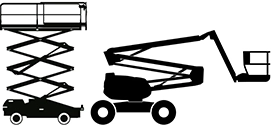
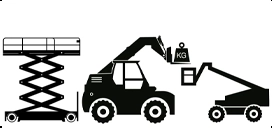
Category 1b: Mast lifts, scissor lifts and similar vertical machines on wheels (driveable from the basket)
-
Category 3a: Vehicle-mounted and articulated (knuckle-boom) platforms – not self-propelled from the basket
-
Category 3b: Self-propelled telescopic and articulating boom lifts (driveable from the basket)
Anyone who has only completed 1b training may not operate a telescopic boom lift with an articulated boom. This is a common mistake on construction sites that leads to an immediate work stoppage during inspections.
Validity and refresher training
The PAL-Card is valid for 5 years. A refresher course must be completed before it expires – otherwise the authorisation lapses automatically. Important: the refresher course generally covers only the practical component; anyone who waits too long may have to repeat the full basic training.
Why machine-specific instruction remains mandatory despite the PAL-Card
The PAL-Card demonstrates basic knowledge. However, it does not replace machine-specific instruction on the actual rental unit. Every aerial work platform differs in control logic, emergency lowering system, safety interlocks and load limits. An operator who has worked with JLG machines for years does not automatically know the operating philosophy of a Haulotte or Genie unit.
Under ArGV 3 and the VUV, the rental company is obliged to document this machine-specific instruction – and the operating company is obliged to request it. Luibl Rental carries out this instruction at handover and provides the corresponding record.
System-Card and National Certificates Compared
Alongside the IPAF PAL-Card, national training schemes also exist, including the System-Card programme, which in the German-speaking region is offered by various trade associations and training providers. In terms of content, the System-Card is comparable to the PAL-Card: theory, practice, category-based authorisation.
The key difference lies in international recognition: the PAL-Card is accepted in more than 60 countries and is often a requirement on major construction sites run by multinational companies. The System-Card is primarily established in German-speaking countries.
Luibl Rental accepts both credentials – what matters is that the category matches the planned use of the machine and that the license is valid.
Written authorisation – the employer's obligation
The VUV requires written authorisation from the employer. This is not a bureaucratic formality but documented confirmation that:
-
the employee is qualified for the specific machine
-
they have been briefed on the risk assessment for the site of use
-
the employer has verified their suitability
If this document is missing, the operator is not legally authorised – even if they can present a valid PAL-Card.
Case Study: Safety Management on a Major Construction Site
A facade construction company rents three telescopic aerial work platforms (Category 3b) from Luibl Rental for a renovation project in a Swiss old town. Project duration: seven weeks, three operators working in shifts.
The problem: Subcontractors are also working on the site. It is unclear who is authorised to operate which machine – and whether all operators are qualified for telescopic boom lifts.
The solution with Luibl Rental:
Before the equipment is handed over, all PAL-Cards and System-Cards held by the nominated operators are checked. Category, validity and suitability for the machine are documented. On-site instruction is then provided for all three machines – separately for each operator, since every platform has a different control logic despite belonging to the same category.
Operators are also briefed on the correct use of fall protection PPE (PPE against falls): on telescopic boom lifts, wearing a fall-arrest harness with an anchor point in the basket is mandatory. The harnesses are not included in the rental – the operating company must provide them. Luibl Rental flags this point if it has not already been addressed in the enquiry.
The result: two weeks later, the site passes an unannounced inspection by the responsible SUVA authority without any objections.
Inspection Under the VUV and Fall Protection PPE
Machine-side safety: the VUV inspection sticker
Every aerial work platform in the Luibl Rental fleet carries a valid VUV inspection sticker upon delivery. The VUV requires work equipment to be maintained and checked (Art. 32b VUV); EKAS Guideline 6512 requires the inspection interval to be set and documented in the maintenance plan. Luibl Rental inspects its rental fleet on an annual cycle, carried out by a specialist within the meaning of EKAS Guideline 6512. For long-term rental contracts, inspection under the VUV is included – no rental partner needs to manage inspection deadlines themselves.
In addition to the annual inspection, Luibl Rental carries out a function check before every delivery: emergency lowering, tilt sensors, end-of-travel limiters, load protection systems. The corresponding inspection records are provided with the machine at handover.
Personal safety: fall protection PPE on boom lifts
On aerial work platforms with a slewing or telescoping boom – specifically articulated, articulated telescopic and truck-mounted platforms – wearing fall protection PPE is required under the VUV. The reason: in the event of a sudden system stop, the operator can be thrown out of the basket by the resulting jolt.
What this means in practice:
-
Fall-arrest harness (EN 361) + lanyard with energy absorber (EN 355) or self-locking fall arrester
-
Anchor point in the basket – not on the guardrail, but at the designated attachment point (follow manufacturer instructions)
-
Restraint belts (EN 358) must not be used as fall protection – they do not stop a free fall
On scissor lifts, fall protection PPE is not fundamentally required under the VUV, but may be specified by the operating company as part of its own risk assessment – for example, when working over water or at great heights inside halls.
Renting Legally Compliant with Luibl Rental
Rental responsibility does not end with a signature on the rental agreement. Anyone operating an aerial work platform takes on an operator's duty of care as a business – with direct consequences for any failures.
The three pillars of legally compliant operation:
-
Training credential: A valid PAL-Card or System-Card with the matching equipment category – for every operator who runs the machine
-
Written authorisation: The employer confirms the qualification and grants formal permission to operate the equipment
-
Machine-specific instruction: Carried out and documented at handover by Luibl Rental – mandatory under ArGV 3 §12 and the VUV
Luibl Rental offers certified training to IPAF standard as well as for the System-Card at its locations. Anyone who cannot yet present a valid credential at the start of the rental period should raise this early – ideally at the enquiry stage, so that the training date and equipment availability can be coordinated.
Questions about operator licenses, training options or the legal requirements for your specific use case are answered by the Luibl Rental team during service hours Mon–Fri, 08:00–17:00.
Rental Terms, VUV and Availability
Daily, weekly and long-term rental: Daily rates for 10-tonne models start at around €200 net, with weekly and monthly rates working out significantly cheaper on a pro-rata basis. For long-term rentals of six months or more, Luibl calculates individual project pricing including inspection under the VUV, annual maintenance and, in some cases, fuel service.
Inspection under the VUV: Every forklift in the Luibl fleet leaves the depot with a valid inspection sticker under the VUV (industrial trucks) and EKAS Directive 6518. For long-term rentals, Luibl carries out the annual re-inspection during the rental period.
Operator training: The VUV requires written authorisation and documented competence of the operating personnel. On request, Luibl offers operator training for heavy-duty forklifts – including the specific hazards arising from load centre-of-gravity shifts and residual load capacity.
Response times and service: In the event of technical faults during the rental period, Luibl provides a service technician directly on site on request. For industrial customers with critical operations, framework agreements with defined response times can be negotiated.
FAQ: Common Questions on Operator Licenses and Safety Obligations
Is a driving license required for self-propelled aerial work platforms?
For self-propelled aerial work platforms (scissor lifts, telescopic boom lifts) on enclosed construction sites and private premises, no vehicle driving license is required. For truck-mounted aerial work platforms: up to 3.5 t gross weight, Category B applies; above that, Category C1 or C.
Is in-house instruction sufficient instead of IPAF training?
Formally, in-house instruction under ArGV 3 §12 is sufficient, provided the employer can demonstrate the qualification. In practice, the IPAF license or System-Card is the recognised standard, as it is accepted by SUVA and site inspections.
How far in advance do I need to book a training date with Luibl Rental?
Please raise this directly when making your rental enquiry. Training capacity is limited, especially for sessions with multiple participants.
Does my PAL-Card apply to all platform types in the Luibl fleet?
No. Each category only authorises operation of the corresponding equipment types. Category 1b applies to scissor lifts and mast lifts; Category 3b to self-propelled telescopic and articulating boom lifts. When you enquire about a machine, Luibl Rental will specify which category is required for the model you want.
What happens if an operator is found without a valid license on a Luibl rental platform?
This is entirely the responsibility of the renting company. Luibl Rental, as the rental company, is not liable for the deployment of unqualified personnel. The operating company bears full responsibility – with possible consequences including fines, work stoppages and civil liability in the event of damage.