Mobile Crane Rental: Powerful Mobile Cranes for Your Project
Luibl GmbH offers mobile cranes for rent for safe and efficient load transport. Reliable solutions for successful projects.
Mobile Crane Rental: Powerful Mobile Cranes for Your Project
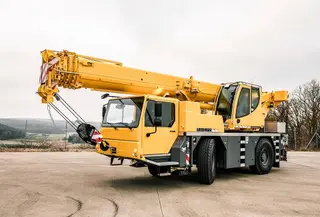
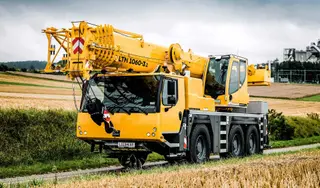
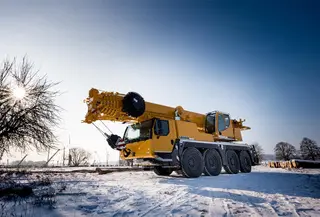
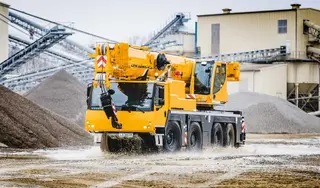
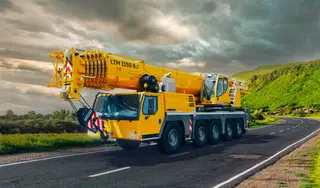
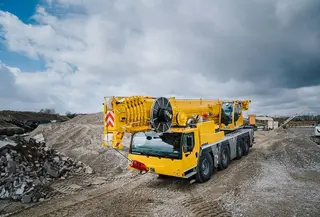
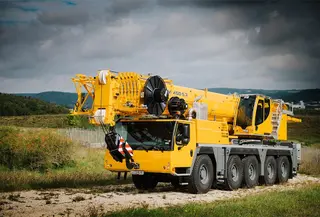
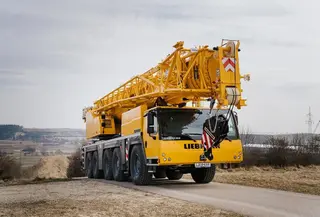
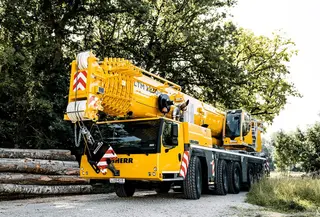
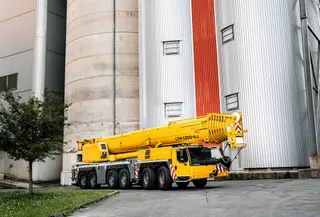
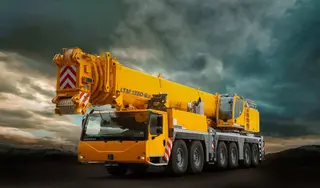
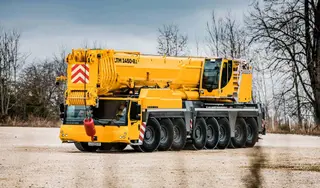
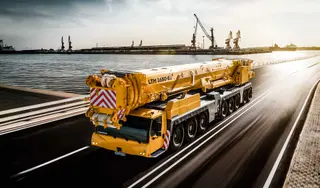
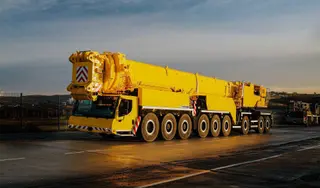
When loads become too heavy for any telehandler and too bulky for any aerial work platform, that's where the mobile crane takes over. At Luibl, you rent Liebherr LTM mobile cranes with lifting capacities from 40 to 750 tonnes and lifting heights up to 152 m – including Europe-wide logistics from our own low-loader fleet and advice from experienced dispatchers.
Whether it's a steel girder over a factory hall, an HVAC unit over a parapet, or a tower section for a wind turbine: the right crane size determines whether your lift sits cleanly the first time – or whether you end up calculating with load capacity reserves that turn out to be expensively missing later.
Finding the Right Crane Size: From 40 to 750 Tonnes Load Capacity
When selecting a crane, what matters isn't the maximum load capacity on the data sheet, but the remaining load capacity at your required radius. A 100-tonne crane only lifts its rated load at minimum radius – at 30 m reach, often only a few tonnes remain. This is exactly where our advisory service comes in: we check load weight, radius, hook height and ground conditions against the machine's load charts.
Liebherr LTM rental fleet (excerpt):
- Liebherr LTM 1040-2.1 – 40 t capacity, 44 m lifting height, 39 m lateral reach, 24 t self-weight. The agile entry-level choice for inner-city assembly work and tight access routes.
- Liebherr LTM 1070-4.2 – 70 t capacity, 50 m lifting height, 48 m lateral reach. The workhorse for steel construction, machine relocation and mid-size construction projects.
- Liebherr LTM 1100-5.3 – 100 t capacity, 62 m lifting height, 64 m lateral reach. Variably supportable with VarioBase – an advantage on confined sites where full outrigger support isn't possible.
- Liebherr LTM 1160-5.2 – 180 t capacity, 99 m lifting height, 78 m lateral reach. The class for industrial assembly and greater reach without a separate heavy-haul transport.
- Liebherr LTM 1300-6.3 – 300 t capacity, 120 m lifting height, 94 m lateral reach. For heavy lifts and major projects with increased reach requirements.
- Liebherr LTM 1450-8.1 – 450 t capacity, 132 m lifting height, 103 m lateral reach, 124 t self-weight.
- Liebherr LTM 1750-9.1 – 800 t maximum capacity, 152 m lifting height, 116 m lateral reach, 140 t self-weight. The top of our fleet – for wind power, bridge construction and heavy-duty plant assembly.
Between these classes, further LTM models in 60, 90, 120, 150, 230, 350 and 650 t are available. This closes the typical capacity gaps that other rental companies have to bridge with the next-larger crane – at a corresponding cost premium.
Gross vs. Net Load: The Most Common Calculation Error
The load chart shows the gross load at the hook. From this you must subtract: hook block, rigging equipment (chains, round slings, spreader beams), and, where applicable, a lattice extension or extended telescopic boom. What remains is the actual net load available for your component. On large lifts, this difference can amount to several tonnes – a point our dispatch team always factors in when recommending crane size.
Renting a Mobile Crane with Operator – Safety Through Expertise
At Luibl, mobile cranes are rented exclusively with experienced operators. This isn't a service platitude – it's a safety-technical necessity: the operation of mobile cranes is governed by the VUV ("Cranes"), and the qualification of the crane operator is governed by the VUV ("Selection, instruction and proof of competence for crane operators").
Our crane operators know their machines over years of experience, are trained in stability conditions, load moment limitation (LML) and the rigging configurations of Liebherr technology – and know when a lift must be aborted. This is precisely the factor that prevents damage claims on critical lifts over existing structures, inside factory halls, or during tandem lifts.
Note: The annual inspection in accordance with VUV is a matter of course for our entire crane fleet. Inspection reports are available on request for project documentation.
Job Planning: What You Need to Know Before Renting
Most delays on lift days aren't caused by the machine, but by inadequate preparation of the setup area. Clarify these points before requesting a quote:
- Setup area and ground conditions: A 100-t crane transfers point ground pressures of several hundred kN/m² under its outriggers. Paved surfaces, block paving or uncompacted gravel rarely withstand this without load-distribution mats. Where there are underground car parks or basement areas beneath the setup surface, a structural assessment is mandatory.
- Outrigger width: Clarify whether the full outrigger base can be used. For restricted conditions, the VarioBase technology on the Liebherr LTM range offers asymmetric outrigger support – with correspondingly reduced load capacity on the restricted side.
- Access: Height restrictions (bridges, gates), load-bearing capacity of access routes, and turning circles. Larger LTM models have axle loads that not every site access road can handle.
- Obstructions: Roof edges, parapets, canopies, overhead lines – every obstacle line between the lift point and the set-down point must be factored into the boom selection.
- Permits: No-stopping zones, road closures, special-use permits for footpaths or slewing over neighbouring properties. Depending on the municipality, these applications must be submitted two to four weeks before the job.
- Load data: Weight, centre of gravity, rigging points of the component. For loads with unknown data, we calculate with safety margins – which pushes the required crane size upward.
If you're unsure about any of these points, that's exactly what our advance consultation is for. Better to ask one extra question than to end up with the wrong crane on site on lift day.
Cost Factors in Crane Rental
There are no flat rates for crane rental for a simple reason: every lift is different. The calculation is made up of these components:
- Lift duration and daily rate for the selected crane size
- Transport to and from the nearest location (Luibl operates over 200 locations across Europe – which generally keeps transport distances short)
- Set-up time for assembly, ballasting and dismantling (for larger cranes >150 t, a separate heavy-haul transport for counterweight and boom extensions is often required)
- Operating personnel (crane operator, plus a signaller if needed for critical lifts)
- Permits and escort vehicles for oversized and heavy transports
- Insurance for the rental period
For long-term rentals and project packages – for instance, if you need crane capacity for a major construction site over several weeks – significantly better terms apply. Talk to us directly about this.
Renting instead of buying: The economic logic
A mobile crane in the 100-t class sits in the seven-figure purchase price range – including the annual inspection under VUV, maintenance contracts, TUEV, insurance, and the ongoing question of whether utilisation justifies the capital outlay. Renting eliminates these variables:
- No capital tied up, no depreciation, no residual-value discussions
- No maintenance and inspection burden of your own
- Scalable crane size – the 70-tonner today, the 300-tonner on the next project
- Always the latest machine generation with up-to-date control and safety technology
For construction companies, industrial operations and plant engineers who don't lift every day, this is the economically sound solution.
Crane Rental at Luibl – Why It Works
Luibl has been a partner to industry, construction companies and general contractors across Europe for years.
Our crane fleet consists exclusively of Liebherr LTM models – meaning consistent spare-parts availability and concentrated expertise instead of a mix of brands. We handle the logistics behind this with our own low-loader fleet as well as network partners, without depending on subcontractor availability whose schedules don't match your construction timeline. With over 200 locations in Germany, Austria, Switzerland, Poland, the Czech Republic, Italy and Hungary, transport distances remain predictable – and if your project needs more than just a crane, we combine the rental directly with aerial work platforms, telehandlers or forklifts, all from one supplier. Our experience in major-account business – from automotive plants to plant engineering to energy infrastructure – shows up concretely in our dispatching: you speak with a dedicated contact who knows your project, instead of working through a call-centre chain.
FAQ – Frequently Asked Questions on Renting a Mobile Crane in Switzerland

What does it cost to rent a mobile crane?
How quickly can a mobile crane be made available?
Is operating personnel included in the rental price?
What load capacity do I need for my project?
Can I combine a mobile crane with other machines?
Request a Rental Quote Now
Send us the load weight, radius, hook height and site location – we'll check the right crane size, calculate the logistics and prepare a concrete rental quote. For complex lifts, we're happy to conduct an on-site inspection on request.