Rent diesel articulating boom lifts with four-wheel drive and oscillating axle – working heights up to 49 m, platform load up to 450 kg. Europe-wide delivery from 200+ locations.
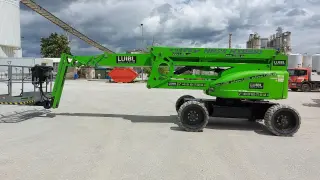
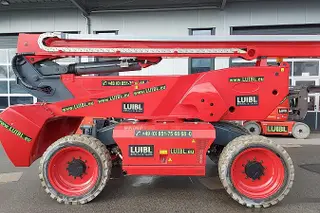
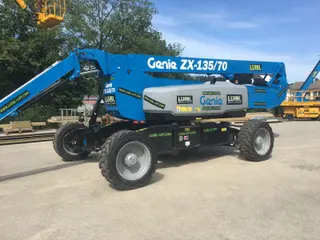
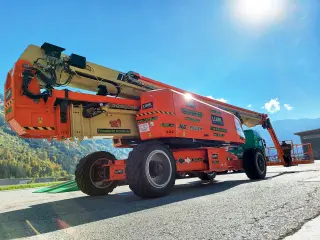
Rent Diesel Articulating Boom Lifts – Maximum Reach for Demanding Terrain
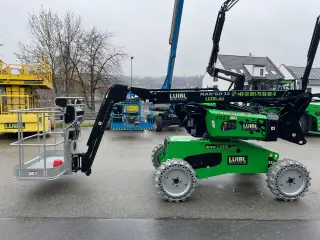
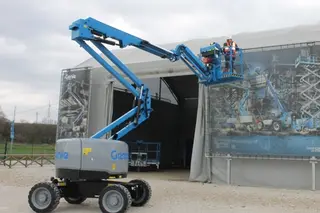
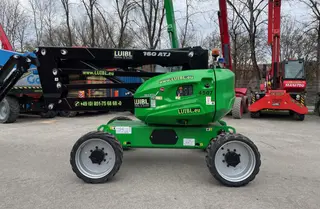
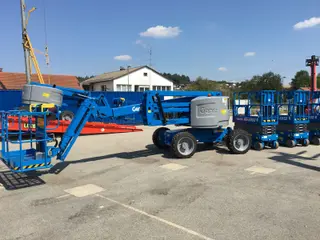
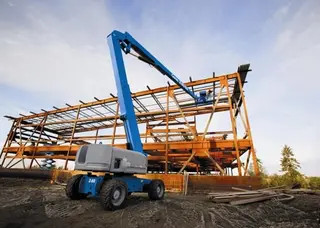
Anyone who needs to reach over a pipe bridge on a construction site, access a façade behind trees, or install a steel structure at a height of 40 m won't get far with a straight telescopic boom lift alone. This is where diesel articulating boom lifts come in: four-wheel drive, articulating boom, oscillating axle and working heights up to 49 m – available for rent with Europe-wide delivery from the Luibl rental fleet.
Why Diesel Articulating Lifts Are Essential for Outdoor Use
On paved indoor floors, electric platforms are sufficient. As soon as gravel, clay, snow or gradients come into play, the situation changes. Diesel articulating boom lifts are designed exactly for this kind of application – for three reasons:
-
Independence from the power grid: On shell construction sites, in steel halls without a power connection, or during tunnelling and route works, an external power supply is rarely available. The diesel engine runs autonomously, and one tank of fuel is enough for several shifts.
-
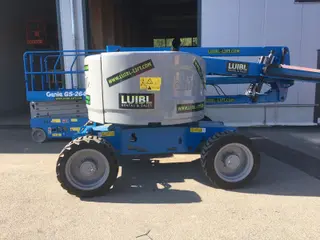
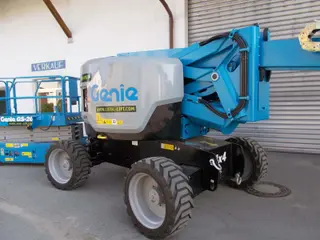
Torque for gradients and ground conditions: Models such as the Genie Z45/25 XC or the Z51/30J RT handle gradients of up to 45%. On gravel or soft ground, the advantage of a combustion engine over battery-powered solutions becomes clearly apparent.
-
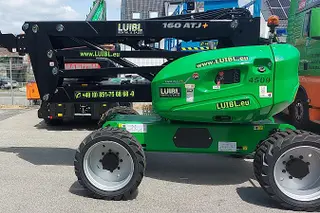
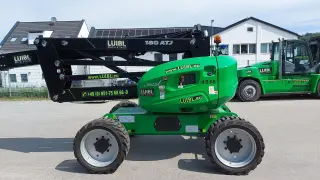
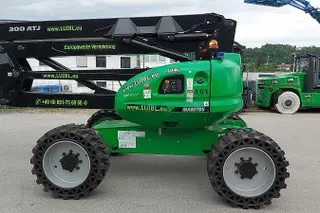
Load capacity and reach in a single machine: Heavy-duty variants such as the Manitou 160 ATJ Plus lift 408 kg into the platform – enough for two fitters plus tools and material. The outreach of this model is 8.52 m.
Compared with a straight telescopic boom lift, the decisive advantage becomes clear as soon as an obstacle lies between the machine and the work point – a roof overhang, a supply line, a projecting structure. This is precisely where the articulating boom becomes the tool of choice.
Up-and-Over Height and Articulation Point – the Technical Difference
The terms working height and up-and-over height are often mixed up in rental listings. For choosing the right machine, however, the distinction is worth real money.
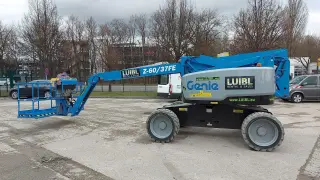
Working height is the theoretical reach of a person standing in the platform – i.e. platform height plus 2 m. On the Genie ZX-135/70, that is 43 m at a platform height of around 41 m. This figure appears in the data sheet and in the rental quote.
Up-and-over height describes something different: how high can the platform be raised while reaching sideways over an obstacle at the same time? This is where the articulation point (riser) comes into play. Unlike a straight telescopic boom lift, an articulating boom lift has one or more additional pivot points on the boom. This allows the platform to be guided over edges, railings or roof overhangs without repositioning the machine.
Outreach depends directly on the model. Examples from the Luibl rental fleet:
-
Genie Z45/25J RT (16 m working height): bridges a distance of around 8 m sideways
-
Manitou 160 ATJ Plus (16.21 m): outreach of 8.52 m at a platform load of 408 kg
-
Magni DAB28RT (28 m): platform rotation up to 180°, endless 360° turret rotation
-
Genie ZX-135/70 (43 m): four steering modes including crab steering and coordinated four-wheel steering
For models with a large working height, negative reach is also relevant – i.e. working below ground level, for example when inspecting the underside of a bridge or working on slopes. Negative working heights down to -6 m are available in the Luibl diesel range.
Applications in Industry and Construction
Diesel articulating boom lifts are not universal machines. They play to their strengths in clearly defined scenarios:
-
Steel construction and hall assembly: Positioning beams, tightening connectors, checking welds – the platform load of 230 to 450 kg allows tools and material to be brought directly to the work point.
-
Façade work on complex geometries: Projections, balconies and roof overhangs are reached from underneath or around using the articulating geometry, without repositioning the machine.
-
Maintenance of supply lines and power poles: This is where negative reach comes into play when working from an earth embankment or dam crest.
-
Bridge inspection and tunnel construction: Long reach up to 49 m and endless turret rotation allow precise positioning even in confined conditions.
-
Industrial assembly in production halls without a power connection: During the construction phase, before the hall infrastructure is commissioned, diesel is often the only option.
Off-road capability through four-wheel drive and oscillating axle
What really distinguishes a diesel articulating lift from an indoor machine is the chassis. Three components are decisive here:
-
Permanent four-wheel drive: Engine power is distributed to all four wheels. This significantly improves traction on gravel, clay, wet ground or snow compared with rear-wheel drive.
-
Active oscillating axle system: On uneven terrain, the oscillating axle compensates for ground irregularities so that all four wheels maintain ground contact. Without this system, the machine would rock on uneven ground, reducing stability.
-
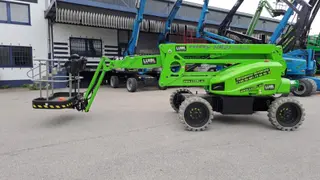
Off-road tyres: Coarse-tread off-road tyres are standard. Individual models (such as the Magni DAB28RT) are fitted with non-marking tyres that roll without leaving marks even on sensitive surfaces – useful for mixed indoor/outdoor use.
Gradeability ranges from 30% to 45% depending on the model. Important: these figures apply when travelling with the boom retracted. Anyone working on a slope must level the machine beforehand – stability is checked via the load chart and tilt sensor.
Selection Criteria for the Right Diesel Aerial Platform
The right machine results from four parameters that should be clarified before every inquiry:
-
Required working height including a safety margin: Better to have 2 m in reserve than to work at the limit. A 16 m platform for a 14 m task is the better choice than a 43 m machine, which is significantly more limited in manoeuvrability.
-
Platform load based on number of people plus material: Two fitters, a cordless drill, connecting material, safety equipment – realistically that quickly adds up to 250 to 350 kg. Models with a 230 kg platform load (Manitou 200 ATJ) are then no longer sufficient.
-
Outreach for actual obstacles on site: This is where the data sheet or advice based on the site geometry is essential. Load charts show which platform load is permitted at which boom position.
-
Transport dimensions and access situation: A ZX-135/70 with a total weight of over 20 t requires different low-loaders and access routes than a 16 m Genie. The delivery dimensions must match the site access.
For sensitive ground, it is worth checking the ground pressure per wheel. Where the ground is critical, tracked platforms (spider lifts) are an alternative – these are also available in the Luibl ra
Regulations, Training and Operating Authorization
Anyone operating an aerial work platform requires operating authorization under VUV in Switzerland. This requires theoretical instruction, practical training and a final proficiency assessment. The employer's authorization must be issued in writing.
The international operator certification is the PAL Card issued by IPAF (International Powered Access Federation), which is required in practice by many general contractors – even though the VUV certificate is legally sufficient.
Other relevant regulations:
-
VUV / SUVA guidelines (incl. EKAS), Chapter 2.10: Operation of aerial work platforms
-
SN EN 280: Safety requirements, calculations and testing for mobile elevating work platforms
-
ArGV 3: Ordinance 3 to the Employment Act, the legal framework for provision and use
-
Austria (AUVA / AM-VO): comparable requirements, governed by the Equipment Ordinance (Arbeitsmittelverordnung)
Before use, a daily visual and functional inspection is mandatory. The annual inspection in accordance with VUV by a specialist is documented on delivery for Luibl rental equipment.
Logistics, Service and Delivery Areas
Luibl operates its own fleet of low-loaders. This is no trivial matter for diesel articulating boom lifts: machines from 16 m working height typically weigh 7.5 t or more, and the ZX-135/70 comes in at over 20 t. External haulage companies often deliver with unclear time windows – the in-house fleet allows for reliable delivery dates, including across borders.
Delivery areas: Germany, Austria, Switzerland, Poland, Czech Republic, Italy, Hungary, Luxembourg and other European countries – from a network of over 200 locations.
Service during the rental period: In the event of technical faults or for operator briefings, fitters can be provided on site on request. This is particularly relevant for large equipment, where downtime jeopardises the daily schedule of the entire construction site.
Long-term rental: For project periods spanning several months, long-term rental terms including the annual inspection in accordance with VUV and annual maintenance are available. This is useful for large construction sites, where the same machine is committed for the entire construction phase.
FAQs: Renting an Articulated Boom Lift in Switzerland

Do I need a driving licence to operate an articulated boom lift?
How much does an articulated boom lift cost per day?
Which articulated boom lift is suitable for indoor use?
What is the difference between an articulating boom lift and a telescopic boom lift?
How much does an articulated boom lift weigh?
Consultation and Availability Check
Which machine suits which task can, in most cases, be clarified within 5 minutes based on the site geometry and the required platform load. For a technical assessment of reach, sideways outreach and delivery time, direct contact with the rental team is the fastest way: https://www.luibl.ch/en/contact/