Scaffolding – When Scaffolding Pays Off and When an Aerial Work Platform Is the Better Choice
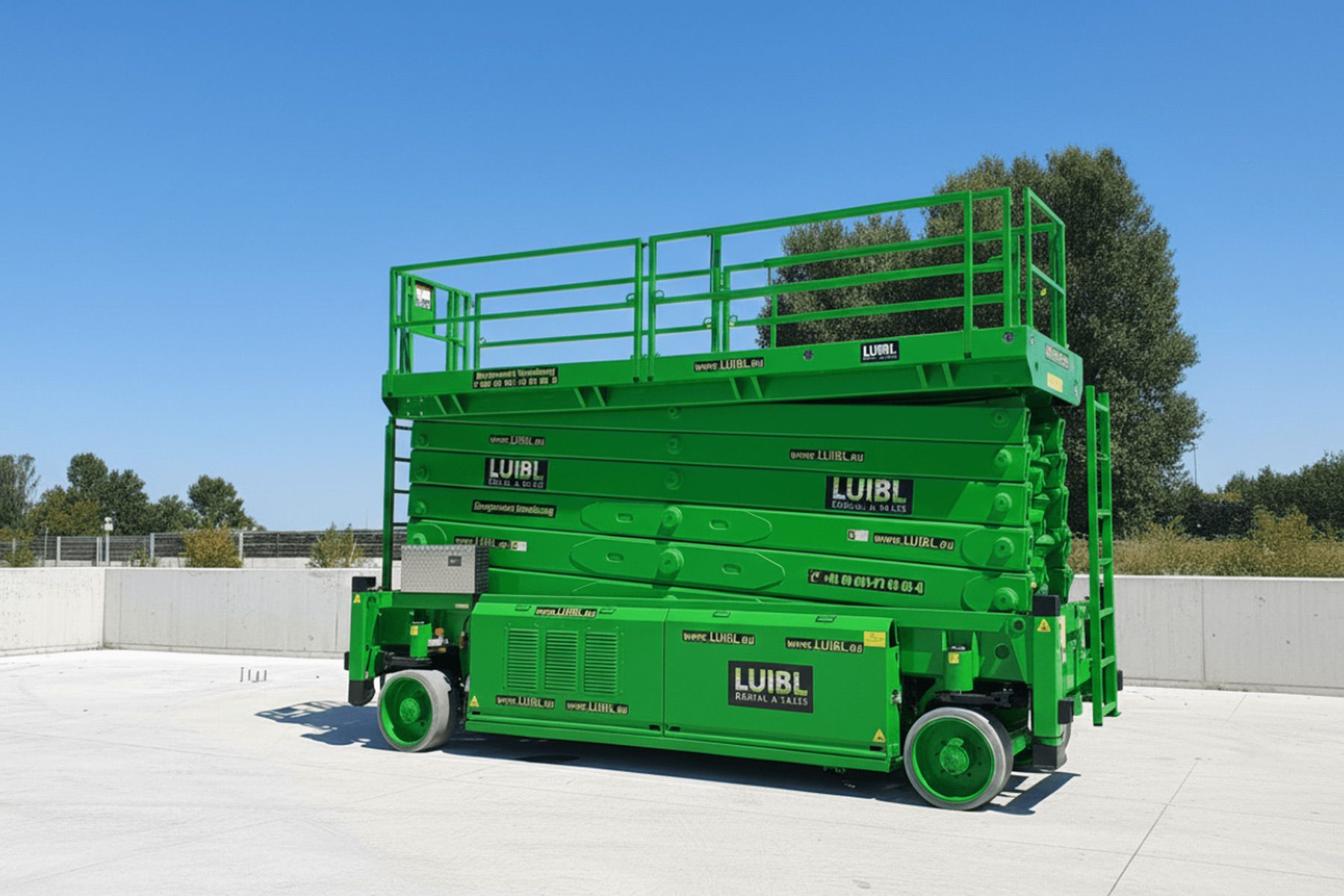
Scaffolding accompanies every larger construction project – from facade renovation to new builds and industrial installation. Yet the stationary facade scaffold has long since stopped being the only option for safe working at height. Over the past two decades, aerial work platforms, telescopic and scissor lifts have developed into a genuine alternative: faster to deploy, more economical for short assignments, and safer for point-specific work above obstacles.
This guide explains the systematics of modern scaffolding, shows which jobs still belong to classic scaffolding – and where an aerial work platform is technically and economically superior. Luibl Rental & Sales specialises in access equipment and supplies aerial work platforms Europe-wide from a network of over 200 locations, replacing or usefully complementing scaffolding in many applications.
Scaffolding – Definition and Distinction
Scaffolding refers to the professional erection of temporary working and protective structures that give people safe access to workplaces at height. A scaffold is a stationary, modularly assembled structure made of standards, decking, guardrails, diagonals and anchors. It is planned on a project basis, erected, inspected and signed off by a competent person, and dismantled once the work is complete.
According to the common standards system, scaffolding falls into three functional main categories:
- Working scaffolds serve as a platform for construction, assembly and maintenance work
- Protective scaffolds protect people and structures from falls or falling parts
- Falsework/shoring scaffolds carry loads from formwork or structural elements during the construction phase
The use of aerial work platforms is a distinct category from classic scaffolding. Aerial work platforms (AWPs) are motorised, mobile machines that lift people and material to the workplace and hold them there. Legally, they are not classed as scaffolding but as work equipment under the Ordinance 3 to the Employment Act (ArGV 3). This has far-reaching consequences for planning, operator qualification and operating costs – we return to this in section 7.
Types of Scaffolding – The Complete Overview
Facade scaffold (frame scaffold)
The facade scaffold is the standard system in German-speaking construction. It consists of prefabricated frames anchored to the facade and connected with decking. Typical manufacturers are Layher, Plettac, Huennebeck, Rux and Altrex. Applications: plastering and painting work, external thermal insulation (ETICS), roofing, facade renovation. Erection and dismantling require trained scaffolders.
Modular scaffold (system scaffold)
Modular scaffolds such as Layher Allround or Plettac Perfect consist of vertical standards with connection nodes at regular intervals. Ledgers and diagonals can be attached at any angle. This allows complex geometries to be built – church towers, stairwells, industrial plants, bridges.
Tower scaffold / mobile scaffold tower
Mobile scaffold towers to SN EN 1004-1 are single-bay, mobile aluminium structures on castors. They are used up to a maximum platform height of 12 m indoors and 8 m outdoors. Assembly is carried out by competent, instructed persons – no scaffolder qualification required. Applications: interior fit-out, small ceiling refurbishments, painting work.
Roof catch scaffold
A roof catch scaffold is a protective scaffold for fall protection when working on pitched roofs. The uppermost decking level sits a maximum of 1.50 m below the eaves, and the catch level breaks the fall of anyone who slips. Mandatory from a fall height of 3.00 m at the eaves.
Room and shoring scaffold
Room scaffolds are erected across an entire indoor area – typical for ceiling refurbishment in halls, churches or railway stations. Shoring scaffolds to SN EN 12812 carry temporary loads, such as concrete formwork in bridge construction.
Suspended scaffold and bracket scaffold
Suspended scaffolds are lowered from above, for example under bridges. Bracket scaffolds project from one side of the structure when a ground-based support is not possible – for instance over water or traffic routes.
Chassis without scaffold function: aerial work platforms as an alternative
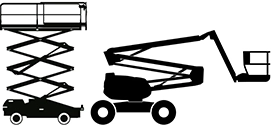
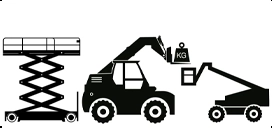
Alongside these classic scaffold types, the aerial work platform has established itself as a fully-fledged alternative for all work where the workplace is a single point or keeps changing. Four main types cover almost every application:
- Scissor lifts – vertical lift, platforms up to 34 m working height, load capacities up to 1,000 kg
- Telescopic and articulating boom lifts – lateral outreach and work over obstacles, up to 58 m working height
- Tracked/crawler lifts – all-terrain with gradeability of over 50%
- Truck-mounted platforms / bucket trucks – fast relocation, no set-up time on site
For many projects where a scaffold used to be ordered reflexively, an aerial work platform is now the more economical, faster and often safer solution.
Technical Comparison – Scaffolding vs. Aerial Work Platform
The table below compares the key figures. Reference values are typical figures for mid-range facade scaffolding and aerial work platforms.
| Criterion | Facade scaffold | Mobile scaffold tower | Aerial work platform |
|---|---|---|---|
| Typical working height | up to 24 m (higher with a stability certificate) | 12 m indoors / 8 m outdoors | scissor lifts up to 34 m, articulated booms up to 58 m |
| Lateral outreach | 0 (facade-bound) | 0 | up to 41 m (articulated boom) |
| Set-up time on site | 1–5 days depending on area | 30–90 minutes | 5–15 minutes (positioning, outriggers) |
| Required qualification | scaffolder, specialist | specialist | operator card (IPAF) |
| Working position | fixed platform | fixed, movable platform | freely positionable in 3D |
| Acceptance/inspection | mandatory after erection | mandatory after erection | periodic inspection per VUV |
| Economical from | assignment duration > 3 weeks | assignment duration > 1 week | assignment duration hours to several weeks |
Bottom line: the shorter the assignment, the greater the lateral outreach required, and the more demanding the terrain, the more clearly the calculation shifts in favour of the aerial work platform.
Applications – When to Use Scaffolding, When an Aerial Work Platform?
Clear scaffolding applications
A scaffold is indispensable when work is carried out across a facade for an extended period. Specifically:
- Facade renovation lasting several weeks or months
- Installing external thermal insulation composite systems (ETICS)
- Roofing and flashing work at the eaves
- Plastering and stucco work with substantial material storage on the working level
Here the scaffold provides a continuous working platform on which material can be stored, cut and processed. An aerial work platform would be economically inferior for these applications, because the dwell time drives hourly rates through the roof.
Clear aerial work platform applications
For the following work, the aerial work platform is technically and economically superior to scaffolding:
- Point-specific maintenance work – individual lights, cameras, air-conditioning units, gutters
- Industrial installations – warehouse lighting, fire protection systems, ventilation technology, sprinkler systems
- Tree care and green-space work – crown maintenance is barely possible with scaffolding
- Facade cleaning – glass surfaces, solar installations, advertising boards
- Work over obstacles – over roofs, plant, water bodies, traffic routes
- Installations in logistics centres – work above racking that is inaccessible for scaffolding
- Short assignments under 2 weeks – where scaffold erection and dismantling take longer than the actual work
The Manitou 160 ATJ (articulating boom lift with 16 m working height) or the Magni RTH 6.39 (rotating telehandler with basket up to 39 m) cover work that would be either disproportionately expensive or simply not feasible with a scaffold.
Hybrid applications
Many projects benefit from a combination. Example: a car plant. For ongoing maintenance of production equipment, the hall is not scaffolded – instead, high-rack scissor lifts with heights of 22 m, 28 m and 33 m are used. On the facade, however, scaffolding remains the basis, supplemented by a truck-mounted platform for hard-to-reach sections.
Selection Criteria for Working at Height
The choice between scaffolding and an aerial work platform follows a robust decision logic. In practice, six questions answer over 90% of all cases:
1. How long will the assignment take? Under 2 weeks: aerial work platform. Over 4 weeks of area-wide work: scaffolding. In between: run the numbers.
2. How many metres of lateral outreach are needed? Zero outreach and work directly on the facade: scaffolding. Any other configuration: consider an aerial work platform.
3. How many people work at height at the same time? More than two people with material: scaffolding. One or two people with tools: an aerial work platform is sufficient.
4. What material needs to be stored on the working level? Nothing to light tools: aerial work platform. Pallets, insulation boards, mortar: scaffolding.
5. What is the ground condition like? Firm and level: all options. Rough or steep: tracked/crawler lift (gradeability over 50%).
6. Are obstacles to be bridged? Yes (roofs, extensions, plant): articulating boom lift. No: scaffolding or scissor lift.
A simple rule of thumb for the construction trade: anyone considering switching from scaffolding to an aerial work platform for the first time typically starts with short maintenance jobs. Hourly rates for an aerial work platform are admittedly higher than the daily scaffolding charge – but set-up time is eliminated, and the job can start within an hour of delivery.
Safety and Regulations
In Switzerland, scaffolding work and the use of aerial work platforms are governed by two interlocking sets of rules: worker protection under the VUV and ArGV 3, and the equipment-specific SN standards. The enforcement body is SUVA; the requirements are set out in more detail in the EKAS guidelines.
Scaffolding
The Construction Work Ordinance (BauAV) applies to construction and facade scaffolds. It governs erection, anchoring, fall protection and use. SN EN 12810 and 12811 (facade scaffolds) and SN EN 1004 (mobile scaffold towers) apply in addition.
Anyone erecting scaffolding needs the relevant professional qualification. Once complete, the scaffold must be checked and released for use in writing; the same duty applies again after any significant modification.
Aerial work platforms
Aerial work platforms are work equipment within the meaning of the VUV. What applies is the maintenance and checking duty under Art. 32b VUV, set out in more detail by EKAS Guideline 6512, with SN EN 280 as the standard.
Swiss law sets no blanket statutory annual interval: the scope and frequency of checks are governed by the manufacturer's specifications, the hazard assessment and the intensity of use. The chosen interval must be set and documented in the maintenance plan.
For operators, the instruction duty under Art. 6 VUV applies: documented induction on the specific machine. An operator card to the IPAF standard is not a legal requirement, but many clients expect one.
Inspection duties at a glance
-
Scaffold: check and written release after erection, daily visual inspection during use, re-check after any significant modification
-
Mobile scaffold tower: erection by instructed persons, release by a specialist
-
Aerial work platform: periodic check by a specialist under EKAS Guideline 6512, induction on the specific machine
Anyone renting aerial work platforms from Luibl receives machines with a valid inspection record under the VUV. For long-term rentals, the recurring inspection is generally included at no extra charge.
Rent vs. Buy – and the Third Option: Buying in a Service
The classic rent-versus-buy decision looks a little different for scaffolding than it does for aerial work platforms.
Renting or buying scaffolding
For private individuals and trade businesses with occasional scaffolding needs, renting through a scaffolding contractor is the norm – including erection, dismantling and structural sign-off. Buying a mobile scaffold tower pays off for recurring in-house needs, for example at painting businesses.
Renting or buying an aerial work platform
Here the calculation shifts considerably. New aerial work platforms quickly cost €40,000 (scissor lift) up to over €350,000 (rotating telehandler). Payback typically kicks in from 150–200 operating days per year. For most businesses, renting is the economically superior option – especially with long-term terms from a 3-month rental period.
The hybrid strategy
Many businesses do best with a clear split: buying a single, frequently used scissor lift for core tasks, and renting specialist equipment (articulating boom lifts, rotating telehandlers, high-rack scissor lifts) on a project basis. Luibl Rental acts here as a partner for specialist equipment, both for end customers and for other rental companies.
When you need neither your own scaffold nor your own platform
For individual projects with a clearly defined duration, a pure rental solution is the way to go. Luibl delivers Europe-wide from over 200 locations with its own low-loader fleet – from Germany via Austria, Switzerland, Poland, the Czech Republic, Italy and Hungary to further countries. Inspection per VUV, induction and, if required, a technician on request are included in the package.
Conclusion and Next Steps
Scaffolding is no longer a monolithic subject. Anyone planning work at height today should consider two parallel worlds: classic scaffolding for area-wide, longer facade work, and the aerial work platform for point-specific, mobile, fast assignments. The distinction is technically clear, and economically often surprising: in many cases the aerial work platform beats scaffolding by a clear margin – even on projects where scaffolding was the reflexive choice.
Luibl Rental & Sales delivers aerial work platforms of every class Europe-wide from over 200 locations – from compact electric scissor lifts for indoor use, to tracked/crawler lifts for rough terrain, to rotating telehandlers with a basket height of 39 m. A single point of contact looks after platforms, telehandlers and forklifts alike – and arranges delivery, inspection per VUV, induction and a technician on request if needed.