Realising Glass Construction Projects Efficiently: Mini Cranes and Vacuum Lifters at Luibl Rental
Glass facades, steel-and-glass structures and laminated panes for atriums, office towers and industrial halls today rarely fall below the 500-kilogram mark. Triple glazing in an aluminium frame for a standard-size office building quickly reaches 380 to 600 kg per element, and special panes for lobbies and showrooms regularly exceed 800 kg. Anyone who has to bring loads like this to a fifth-floor installation point through a stairwell or across an inner courtyard will find a mobile crane defeated by the lack of set-up space, an aerial platform defeated by its load capacity, and manual labour defeated by the VUV.
The answer lies in combining a mini crane and a vacuum lifter – two machines that each have their own speciality on their own, but together become the only economical solution once the site is tight, the ground is sensitive and the load is demanding. Luibl Rental keeps a coordinated rental offering ready for exactly this application profile. The mini crane fleet is built on the Maeda range, with models from the 600 mm-narrow MC104C to the heavy-duty MC815C with over 8 tonnes of load capacity. The matching vacuum technology is supplied by Luibl Group's sister brand Uplifter – glass lifters with 1- and 2-circuit systems up to 1,200 kg capacity that attach seamlessly to the load hook of every Maeda crane.
This pillar page provides the in-depth view: which technological synergy between crane and lifter decides project success? What load capacity reserves are actually usable at which reach? And what does practice look like with an 800 kg facade element in an inner-city setting?
The technological synergy: why the combination decides success
A mini crane alone lifts – a glass lifter alone holds. Only the combination of both systems allows what matters in glazing work: low-contact, precisely guided positioning of large glass elements in confined conditions. Three technological characteristics must reliably work together between the crane and the attachment.
Proportional control as the prerequisite for millimetre-precision work
The first key is the crane's proportional control. On a Maeda MK3053CB, for example, every joystick on the radio remote control can be adjusted steplessly between standstill and maximum speed. In glazing work this is not a convenience feature but a basic requirement. A 600 kg laminated safety glass pane hanging from a vacuum lifter on the crane nose swings out with every jerky movement of the hoist winch – with inertia that releases several hundred joules of kinetic energy over a half-metre swing radius. A single contact between the swinging pane and the steel frame or an adjacent glass edge results in breakage.
The crane's proportional radio remote control lets the operator guide lifting, lowering, slewing and boom movement in the finest speed increments. Maeda calls this system on its models "full proportional control with HBC radio" – an industry-established standard that operators master precisely after brief training.
Vacuum safety circuit: single-circuit versus dual-circuit system
On the lifter side, the number of independent vacuum circuits determines the permitted range of application. A single-circuit system generates vacuum via one pump and a shared tank for all suction pads. It is light, low-maintenance and adequate for supervised indoor installation.
However, as soon as lifting takes place over people, traffic routes or above 2 metres of lift height, the VUV requires a dual-circuit system for loads carried over people. Here two fully separate vacuum circuits operate with their own pumps, their own tanks and their own gauges – if one circuit fails, the second continues to hold the load safely. The Uplifter UPG series from the UPG600 upward, as well as the Glassworker GW1125, come with this redundancy as standard, including battery power independent of the mains. This is the minimum standard for any outdoor facade installation.
Pick & carry function: moving loads while travelling
The third synergy point is the crane's pick & carry function. Conventional mobile cranes deploy outriggers and lift from a stationary position. A Maeda MC405C-3, by contrast, can transport a load while travelling, as long as it stays within the free load chart – with the boom retracted and the machine in travel mode. This lets glass elements be moved directly from the delivery point at the site fence to the installation position without needing to be set down or repositioned in between.
Combined with the low ground pressure of the rubber tracks – 0.52 kg/cm² on the MC405C-3 – this creates a system that can even cross freshly laid parquet, marble or natural stone flooring in foyers and showrooms without leaving pressure marks. The combination of pick & carry and low ground pressure eliminates the intermediate steps that consume most of the installation time with conventional lifting equipment.
Load moment limiter: the invisible protective layer
Every Maeda mini crane in Luibl's rental fleet has an electronic load moment limiter (LML) that continuously compares the product of load and reach against the permissible load moment for the current boom position. If the value is exceeded, the system automatically shuts down the critical movement – typically further extension or lowering of the boom. On models with a knuckle-boom design such as the MK1033CW1 or MK3053CB, the LML additionally monitors the knuckle angle, because the load-moment curve behaves non-linearly at these knuckle transition points, which is where the greatest risk of overload situations arises.
The LML is not a convenience feature but mandatory equipment under SN EN 13000 and a prerequisite for inspection under the VUV. At Luibl Rental, no mini crane leaves the depot without its LML having been verified with calibrated test weights as part of the recurring inspection under the VUV "Cranes".
Technical specifications for experts
Choosing the right mini crane for a glazing project is not a matter of gut feeling but a calculation based on three variables: maximum load in kg, required lateral reach in m and lift height in m. Transport width, ground pressure and drive type are added as knockout criteria as soon as door openings, sensitive flooring or low-emission indoor areas come into play.
Maeda rental fleet at Luibl Rental – key data for the main models
Maeda MC104C – The ultra-compact indoor specialist
-
Maximum load capacity: 990 kg at 1.1 m reach
-
Maximum lift height: 5.5 m
-
Maximum reach: 5.1 m at 200 kg
-
Transport width: 600 mm – fits through standard doorways and goods lifts
-
Drive: electric motor, locally emission-free
-
Application profile: indoor installation in lobbies, stairwells, atriums, refurbished period buildings
Maeda MC174C – More power in a compact form
-
Maximum load capacity: 1,720 kg
-
Maximum lift height: 5.5 m
-
Maximum working reach: 5.2 m
-
Transport width: 590 mm
-
Application profile: heavier glass elements in confined interiors, steel-beam installation in existing buildings
Maeda MK1033CW1 – Knuckle-boom specialist with slim body
-
Maximum load capacity: 995 kg at 11.3 m lift height and 9.9 m working range
-
Fully automatic knuckle boom for working over obstacles
-
Transport width: 750 mm
-
Application profile: glazing behind projections, in inner courtyards, over roof overhangs
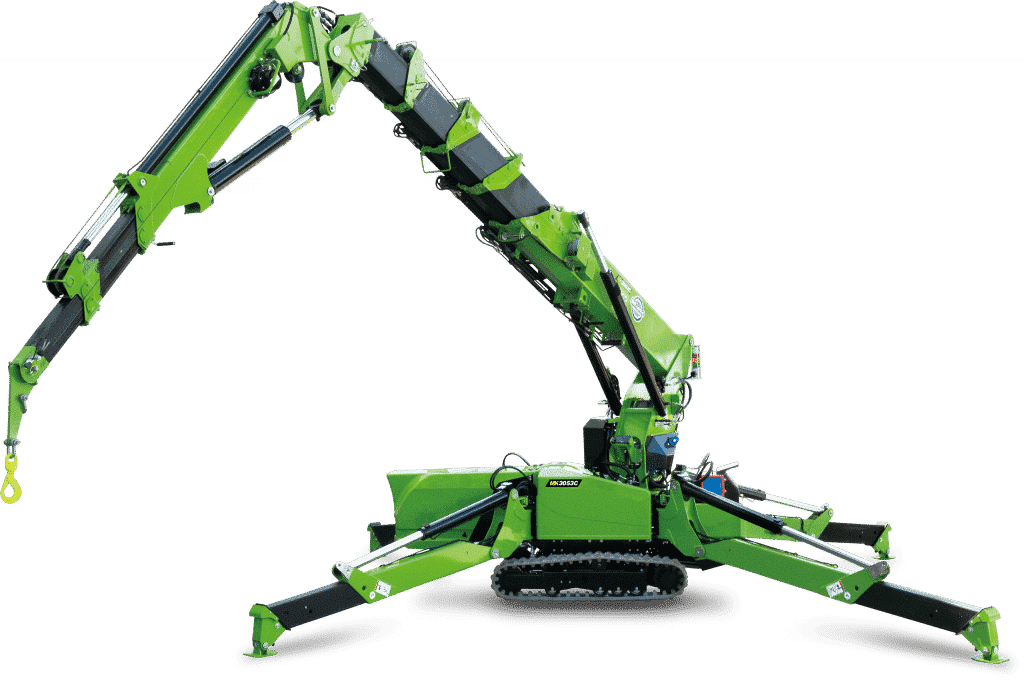
Maeda MK3053CB – Battery-powered professional with knuckle boom
-
Maximum load capacity: 2,800 kg at 1.8 m reach
-
Maximum lift height: 16.95 m
-
Maximum working range: 14.3 m
-
Drive: battery, fully electric, locally emission-free
-
Radio remote control with full proportional control
-
Application profile: medium-weight facade installation, emission-sensitive areas, inner courtyards
Maeda MC405C-3 – All-rounder for outdoor sites
-
Maximum load capacity: 3,830 kg
-
Maximum hook height: 16.80 m
-
Ground pressure: 0.52 kg/cm² – gentle on sensitive surfaces
-
Gradeability: 20°
-
Travel speed: up to 3.3 km/h
-
Application profile: heavy facade elements, outdoor installation on sensitive ground
Maeda MC815C – Heavy-duty class
-
Maximum load capacity: 8,090 kg at 2.4 m reach
-
Maximum hook height: 19.6 m (optional with hydraulic jib up to 25.5 m lift height)
-
Maximum working range: 18.8 m at 340 kg load
-
Own weight: 9,460 kg
-
Application profile: large-format facade elements, heavy special glazing, industrial roof light strips
Knuckle transition points: what the load chart doesn't tell you
A frequently underestimated issue with knuckle-boom mini cranes are the so-called knuckle transition points in the load chart. While the chart suggests smooth load capacity curves across lift height and reach, in reality there are transition zones where the permissible load changes abruptly – namely wherever the knuckle boom changes geometry (folded in versus extended) or where the main boom passes a critical angle threshold.
In practice, this means: a Maeda MK3053CB can lift an 800 kg load at 5 m reach without issue, but at 5.5 m reach with the same boom angle only 650 kg, and at the transition to knuckle-arm use the permissible load at an identical geometric position drops to 580 kg. The LML protects against overload, but an experienced operator plans the lifting sequence so that these knuckle transition points are not crossed within the critical load range – this prevents unwanted shutdowns mid-movement.
At Luibl Rental, handover of every knuckle-boom mini crane includes a machine-specific operator briefing with the original load chart. Anyone taking over a mini crane without this briefing is taking on a risk that has no place on a construction site.
Vacuum lifters from sister brand Uplifter – load capacity classes
The vacuum technology within the Luibl Group comes from Uplifter, the German specialist in vacuum lifting technology, which has worked project-by-project with Luibl Rental's rental fleet since being acquired by the Luibl Group. The key glass lifter models for combination with Maeda mini cranes:
Uplifter UPG350
-
Load capacity: 350 kg
-
Attaches to almost any device with a load hook
-
Single-circuit system
-
Application profile: standard glazing indoors, window installation
Uplifter UPG600 / UPG1000
-
Load capacity: 600 kg / 1,000 kg
-
Dual-circuit system with redundant vacuum supply
-
Battery power for mains-independent operation
-
Application profile: medium-weight facade elements, outdoor installation
Uplifter glass lifter UPG1200
-
Load capacity: up to 1,200 kg
-
Dual-circuit system with up to 12 suction pads
-
Suction pads variably positionable via extensions
-
Radio remote control with electric tilt unit
-
Silicone-free suction pads (no marks left on the pane)
-
Application profile: heavy glass facades, laminated safety glass, special glazing
Uplifter Glassworker GW1125
-
Load capacity: max. 2,000 kg
-
Motorised 360° rotation, hydraulic 90° tilt
-
Two independent vacuum circuits with dual safety per circuit
-
Reserve vacuum tank, mains-independent 12 V battery power
-
Application profile: large-format glass facades, industrial glass, heavy metal panels
Anyone renting a Maeda mini crane from Luibl can, on request, get the matching suction system in a single delivery via sister company Uplifter. The combinations are technically validated and comply with applicable safety standards.
Case study: 800 kg facade elements in an inner-city setting
Theory is decided on the construction site. A representative scenario from urban glazing work illustrates where the real value of the mini crane–lifter combination lies.
Starting position
An office building in an inner-city location is receiving a new shopfront made of laminated safety glass on the ground floor. Six elements measuring 3.20 m × 2.10 m, each weighing 800 kg, are to be installed while the adjacent retailers remain in ongoing business operation. Delivery is via low-loader from the street, which is only permitted to stand for a 30-minute parking window. Between the low-loader and the installation position lie 18 metres, a 90-degree bend, a section of cobblestone paving and the building's entrance area with sensitive natural stone flooring.
Setting up a mobile crane is out of the question: the usable carriageway width is 4.2 m, and a full road closure cannot be approved during business hours. An aerial platform is ruled out for lack of load capacity. Manual installation with suction traverses and personnel is likewise out of the question given the load and the VUV requirements.
Solution approach
Luibl Rental deploys the combination of a Maeda MC405C-3 (3,830 kg load capacity, low ground pressure) and an Uplifter UPG1200 glass lifter (1,200 kg, dual-circuit system, radio remote control). Both units are delivered together on Luibl's own low-loader, one logistics run, one handover appointment.
Step 1 – Delivery and positioning: The MC405C-3 is driven off the low-loader; with the boom retracted it passes through the entrance foyer (ground pressure 0.52 kg/cm² – no pressure marks on the natural stone). Set-up takes place inside the building next to the installation location.
Step 2 – Picking up the glass element: The UPG1200 is attached to the crane's load hook. The radio remote control allows independent control of lift, slew and lifter tilt. The first 800 kg element is taken off the low-loader, and the MC405C-3 uses its pick & carry function: with the load attached, the crane travels to the installation position at reduced speed.
Step 3 – Positioning: At the installation position, the UPG1200 hydraulically tilts the glass element from the horizontal transport position into the vertical installation position. The electric tilt unit allows this in a single controlled movement. Using the crane's proportional control, the element is set onto the mounting pins on the steel frame – tolerance ±2 mm.
Step 4 – Repetition: The remaining five elements follow the same procedure. Total installation time for six elements: 4.5 hours, including two breaks for the UPG1200's battery care.
Result
What would have cost several days of permitting and a complete shutdown of the retailers' business with a mobile crane and road closure took half a working day with the Maeda-Uplifter combination. The low-loader's stop at the site fence stayed within the 30-minute window. No damage to the flooring, no noise nuisance for residents – the Maeda MC405C-3 runs on diesel but can also be supplemented with electric battery units if the indoor phase must run emission-free.
Safety in glazing work: PPE and acceptance protocols
Glass installation is a hazard-assessment-obligated activity under ArGV 3. Three components must be documented before work begins.
Personal protective equipment (PPE)
For everyone involved in the lifting operation, the following applies:
-
Cut-resistant gloves class F (highest protection level against cuts, EN 388)
-
Safety shoes S3 with puncture-resistant sole and toe cap
-
Safety helmet EN 397
-
Safety glasses when working under the load or during grinding/drilling work on the glass edge
-
Fall-arrest harness and lanyard for work in fall-hazard areas from 2 m height, under the VUV
For outdoor installation in fall-hazard areas, a separate rescue plan with a defined recovery scenario is additionally required.
Acceptance protocols before lifting begins
Before the first load-lifting operation, the following points are compared in writing and countersigned by the responsible operator:
-
Current inspection under the VUV of the crane with a valid inspection sticker under the VUV (competent-person inspection at least annually, expert inspection every four years)
-
Current inspection of the vacuum lifter under the VUV with a documented function test of both vacuum circuits
-
Load chart of the crane for the planned lifting configuration (reach, lift height, boom angle)
-
Written load weight confirmation from the glass manufacturer
-
Set-up ground assessment: bearing capacity of the ground in kg/cm², compared with the machine's ground pressure at full load
-
Weather log: wind speed (critical value for glazing work typically 6 m/s at ground level, varying by the pane's wind exposure area), precipitation, visibility conditions
-
Operator qualification: crane operator certificate under the VUV and vacuum lifter induction
Luibl Rental delivers every mini crane with a current inspection report and a brief safety briefing at the handover location. Responsibility for the site-specific hazard assessment remains with the executing company – Luibl supports this with templates and advice through its training centre.
Operator qualification: what is required
In Switzerland, operating a mini crane requires documented instruction under Art. 6 VUV together with the specific device induction for the respective model; for cranes, the requirements of the Crane Ordinance (SR 832.312.15) apply in addition. In Austria the equivalent rule under AUVA M-plus 815 applies, supplemented by annual instruction under AM-VO. In Switzerland, operators are trained and certified under SUVA/EKAS requirements and the recurring inspection obligations under the VUV. Anyone working with a vacuum lifter additionally needs induction in the lifter system under Art. 6 VUV.
Luibl Rental offers both courses through its certified training centre. The operator certificate is valid for 12 months and must be renewed through the annual in-house instruction.
Logistics and service: own low-loaders, Europe-wide delivery
Maeda mini cranes are not standard equipment – their own weight, ranging from 1.9 tonnes (MC104C) to 9.5 tonnes (MC815C), together with their special dimensions, requires adapted transport solutions. Luibl Rental operates its own low-loader fleet, bringing machines and vacuum technology to any site in Europe in a single delivery.
Delivery areas include Germany, Austria, Switzerland, Poland, the Czech Republic, Italy, Hungary and other European markets. Through the network of more than 200 locations and group subsidiaries, Luibl also responds to short-notice enquiries with correspondingly short delivery times. For large projects and long-term rentals, terms are available with integrated inspection under the VUV and annual maintenance included – no extra effort for the tenant, no downtime due to expired inspection intervals.
During the rental period, an on-site service is available. In the event of technical issues or operating questions, a technician can be on site at short notice. For longer projects with intensive machine use, a dedicated operator can also be requested – an experienced operator accompanies the project and carries out the lifting operations.
For the vacuum technology, the parallel logistics of sister brand Uplifter apply: glass lifters are delivered directly with the mini crane, and technical advice on lifter selection and safety equipment is provided by the Uplifter team in close coordination with Luibl Rental.
When is the combination worthwhile – and when isn't it?
An honest assessment is part of every consultation. The combination of mini crane and vacuum lifter is the right solution when at least three of the following conditions apply:
-
Glass elements over 200 kg need to be installed
-
The site is inaccessible to mobile cranes (interiors, inner courtyards, listed building fabric, narrow access routes)
-
The ground is pressure-sensitive (natural stone, parquet, freshly laid flooring, underground car park ceilings)
-
Installation must be low-emission or low-noise (hospitals, residential areas during night work, sensitive customer areas)
-
A 360° pick-and-carry movement is required, moving the load from the delivery point to the installation position without an intermediate set-down
The combination is not the right solution if the glass element weighs under 80 kg and can be safely installed manually by two people using a hand-held suction lifter, if a mobile crane can be set up without issue (open-air industrial construction, open large sites), or if the lift height is well above 25 m – here, classic cranes or rotating telehandlers are the more economical choice. For lift heights between 15 and 30 metres, it is also often worth taking a look at Luibl's rotating telehandlers as an alternative.
International standards and market developments
Requirements for glazing work are internationally harmonised. EN 13000 governs safety requirements for mobile cranes, EN 1492-1 governs sling testing, and EN 13155 governs requirements for non-fixed load-lifting attachments – glass lifters fall directly under this standard. Anyone working in Austria, Switzerland or beyond the EU's borders must comply with these standards regardless – in Switzerland, SUVA and EKAS directives implement them locally.
On site, the trend towards locally emission-free drives continues to gain momentum. Luibl Rental keeps pace with the electric variant of the MC104C, the battery-powered MK3053CB and, going forward, further hybrid models that run emission-free in electric mode. For inner-city sites with municipal noise-control requirements and for emission-sensitive areas such as food production or hospitals, these machines are the only legally compliant solution.
Luibl Rental and Uplifter as consultants on an equal footing
Glazing work is precision work under physical constraints that rarely leave much room for manoeuvre. Choosing the right lifting technology is not a question of the daily rental price, but a question of project safety, compliance with VUV and ArGV 3 requirements, and ultimately economic efficiency over the entire construction phase.
With the Maeda mini crane fleet and the vacuum technology accessible through sister company Uplifter, Luibl Rental offers a coordinated overall system that has few equals in the German-speaking rental landscape. Over 200 locations, its own low-loaders, integrated inspection under the VUV for long-term rentals, and a certified training offering are not marketing terms but operational reality – and exactly what makes the difference between project success and an insurance claim when handling an 800 kg glass element on the fifth floor.
Enquiries and consultation: Get in touch with the Luibl team via the contact form. For vacuum technology and glass lifters, enquiries are forwarded directly to the Uplifter specialists – one point of contact, one quote, one delivery process.
Frequently asked questions about mini crane and vacuum lifter rental
What load capacity do I need for a standard glass facade pane?
A triple-glazed laminated safety glass pane measuring 3.0 m × 1.5 m weighs approximately 280 to 360 kg, depending on glass thickness and the aluminium frame. With a safety factor of 1.5, the lifter should offer at least 540 kg and the crane at least 600 kg at the required reach. Precise sizing is determined from the load chart before the rental enquiry.
What does it cost to rent a Maeda mini crane per day?
Daily rental for a Maeda MC104C starts in the compact-model range and rises significantly up to the heavy-duty class of the MC815C. Actual daily rates depend on rental duration, delivery area and additional services such as an operator or vacuum lifter. Luibl Rental prepares project-specific quotes rather than flat rates – that is standard practice for specialist equipment.
Do I need separate training for the mini crane and the vacuum lifter?
Yes. The operator certificate under the VUV covers crane operation. For the vacuum lifter, separate induction under Art. 6 VUV is required. Luibl Rental offers both courses through its own training centre, often combined in a single training programme.
Can I rent the mini crane and vacuum lifter separately?
Technically, yes. In practice, combined rental is in almost all cases the more economical solution, because the logistics (low-loader, handover appointment, return) are bundled. For pure hook applications without glass or panels, the lifter rental is of course not needed.
How quickly can Luibl deliver?
For standard enquiries from German-speaking countries, at short notice. For urban special assignments with an unusual configuration, lead times of up to a week can arise – an early enquiry helps. Through the network of over 200 locations, short-notice scheduling is also possible.